|
|
Bill Ward discovered that drawing
might be something more than a hobby at Ocean City,
Maryland when he was seventeen. He earned enough painting
pictures on other kids' jackets to support himself
through the summer. And more than earning money, as Ward
says, "what a fantastic way to meet girls."
What better motivation could a young man want!
Ward enrolled in the Pratt
Institute in Brooklyn. Right away, Ward started
specializing. He drew girls. Ward took little advantage
of attending one of the finest commercial art schools in
the country. With the certain advent of war and the
knowledge that he'd be going into the service when he
turned nineteen, he neglected his studies and
concentrated on girls and fraternity life. In his own
opinion, he wasn't a good artist when he graduated in
1941.
Ward's first job after school was
with a Manhattan art service, but this proved a major
disappointment when he learned his work was to clean up
for the illustrators. He soon managed to get himself
fired from this job and found himself working for Jack
Binder, drawing backgrounds for Fawcett's comic books,
including Mr. Scarlet, Bullet Man, Ibis and The Shadow.
Ward credits Binder with teaching him the real skills he
needed to become one of the best comic book artists of
the period.
Ward got his big break when he
did an entire Captain Marvel book. He decided to try for
a job at Quality, the top comic line at that time. His
timing was perfect. Reed Crandall had just been drafted
and Quality offered him Blackhawk. Ward was somewhat
overwhelmed. He had only hoped to do a secondary story in
one of their books. Instead he was replacing who was, in
Ward's words, "the greatest comic book artist of
them all." According to Ward, his training by Jack
Binder had prepared him well for Blackhawk. All of his
practice in inking paid off. Quality particularly liked
his covers. Ward comments:
"I'm
especially proud of Military No. 30, a shot of that
silly Blackhawk plane coming at you, cannons firing,
Blackhawk piloting, Chop-Chop waving his meat cleaver
menacingly over his shoulder. I drew that idiotic
plane (from the early Military Comics) for years
before it was changed to a jet. I used to wonder what
nut designed the damn thing. Of course it could never
fly -- ridiculous to think so. A few years ago I was
leafing through a copy of a 1942 Aerosphere that I
had acquired. Imagine my astonishment . . .there it
was, an actual photograph of that same silly plane!
Reading on I found it was an experimental model, the
Grumman Sky Rocket, that the army had rejected. Can
you blame them? . . . but it must have at least flown!"
Ward was at the top of the comic
book world, when as had happened to many others before
him, he was drafted. After training, Ward was assigned to
communications for an anti-aircraft unit at the Quonset
Point Naval Air Base, R.I. His duties left him with
plenty of spare time so he began laying out stories for
Fawcett during his long night tours. A naval officer
noticed his work and suggested he do a strip for the base
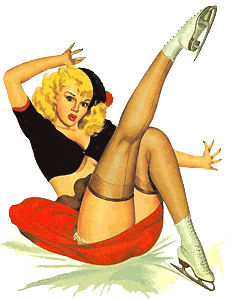
paper. Ward did, and created Ack-Ack Amy. That strip
eventually evolved to become the character for which he
is best known, Torchy, the blonde bombshell.
Never again was he to
create the classic Blackhawks that he did in 1941-42. His
bold yet simple inking style was lost as the inkers
butchered his pencilling. He and I were destined to go on
doing Blackhawk this way for seven years:-
"Drawing
Blackhawk was probably as difficult a job as there
was in the comics. There were seven main characters
and they had to be shown constantly, really
overcrowding the panels. I envied the writers;
they could type out 'Show all seven Blackhawks in a
mêlée with the thugs' in probably ten seconds. Imagine
how long it took me to draw it. One of the most
difficult things I found about drawing the Blackhawk
characters was their military hats. A hat has to look
just right, if it doesn't it looks silly. There's no
in-between. Agitated about pencilling and the length
of time it took me, I developed a way of solving the
hat problem. I had them all knocked off in their
first fight, which usually occurred by the second
page. Then for the rest of the story they would be
bare headed. I got away with it for about six months,
then, not some astute editor, but some damn smart
aleck kid wrote George Brenner (the head editor at
Quality), 'Why don't the Blackhawks get a new hatter?
They don't seem to fit very well. They all get
knocked off at the beginning of each story.' They
really ripped into me over this. So in the next story
the Blackhawks all had to swim underwater out to a
submarine. You're right, I drew them swimming
underwater with their hats on. 'All right, Ward,
let's not overdo it,' George Brenner screamed into
the phone."
Around 1946, Busy Arnold,
Quality's publisher, asked Ward if he had any ideas for
another story for Modern Comics. Ward suggested Torchy,
the strip about the daffy blonde that he had created
while he was in the Army. It quickly became a big success
and even got its own book. Ward's particular talent for
drawing women stood him in good stead in this period when
romance comics became very popular. Ward was soon so busy
doing the covers and lead stories for Quality's romance
comics that he didn't have time for his own creation and
Torchy was turned over to another talented artist, Gil
Fox. But Ward's career in comics was nearly finished
anyway. It was the early fifties, and Dr. Wertham's
campaign to paint comics as bad for kids was having
effects. Soon the diminished sales caused Quality to go
out of business.
Ward found other work drawing
cartoons for Abe Goodman's Humorama, and in 1954, at
Cracked magazine where he continued for many years.
Reference:
The Man Behind Torchy, by Bill Ward.
Biography by DLT.
|